Art during the air alarm: an interview with Eleonora Hrybniak about her project “Luftalarm”

Important: This article was translated from Ukrainian with the help of DeepL.
On November 2, 2024, an art exhibition was held in Austria. One of the works presented was the project “Luftalarm” (eng: “Air Alarm”) by Ukrainian artist Eleonora Hrybniak. You can find out more about how the first time she heard an air raid alarm inspired her to create an art project, as well as many other things in the interview with the author of the work.
“Luftalarm” (eng: “Air Alarm”) is an art project by Eleonora Hrybniak, which is a crocheted blanket, each line of which reflects the duration of the air alert in Odesa region every day since February 12, 2024. Different levels of air alarm duration on a given day are depicted in a different color according to a conditional scale.
What this interview is about:
- About moving to Austria
- About visit to Ukraine and hearing the air alarm for the first time
- About an art project related to air alarm
- About the presentation of the work at an exhibition in Austria
- About the unusual location where the exhibition took place
- About the works of other participants of the exhibition
- What visitors were interested in and what Austrians think about the situation in Ukraine
- About photography, ideas and museums
About moving to Austria
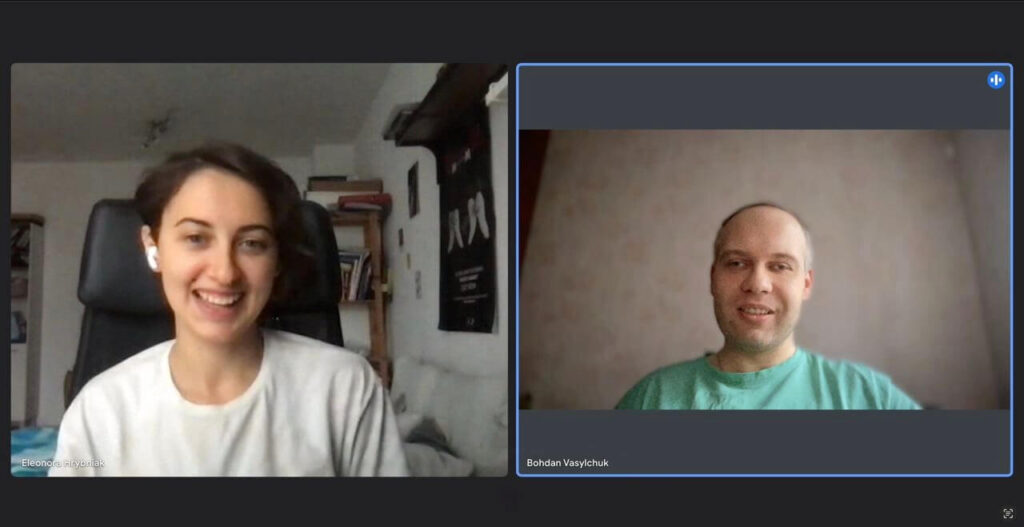
– You are from Odesa, but now you live and study in Austria. How long ago did you come to Austria, what do you do there, where do you study?
I have been living and studying in Austria for three years now. I moved here because I entered the University of the Arts in Linz for the art photography program… although you could say faculty. The program itself is called simply “Visual Arts”. Before that, I lived with my relatives in Germany for 8 months, and during that time I learned German completely. Well… almost completely (laughs).
– Now you are finishing your studies in Austria, as I understand it?
No, here I can say that I started from scratch. Because this is a completely different field of study (I already have an education – I studied applied physics and mathematics). And this is one of the last programs that is still not under the Bologna system, it lasts about 4 years.
– And how did it happen that you were an applied mathematician and physicist and suddenly it changed to photography?
Yes… (laughs). I heard this question very often. In general, I studied at a lyceum in Odesa with a focus on physics and mathematics. It runs in my family: my father taught math, my mother also graduated in applied mathematics, my grandmother taught physics, and my great-grandfather taught astronomy. No one in my family was involved in art, but I always had an interest in photography. I just didn’t know how to approach it, how to make it my life’s work…
About visit to Ukraine and hearing the air alarm for the first time
– In our correspondence, you said that on February 12 (note: 2024) you arrived in Ukraine and that was the first time in your life that you heard a real air alarm. What were your emotions and feelings at that moment?
Yes, on the 12th, there was no alarm in Odesa, but the next day. I had just agreed to meet my friend. I just got out of the taxi, as usual, taking pictures of cats on the street, and then the alarm started screaming. And in reality, when you are alone, it feels even more frightening, no matter where you are.
– How long did you stay in Ukraine then?
10 days
– During this time, did you have to face any real shelling or explosions?
(pauses thoughtfully) I once…, again, I was walking with my friend, and air defense was working…, and I was a little bit freaked out…
– And did you hide somewhere or go to a shelter…?
Well, to be honest, the situation with shelters in Odesa is not so simple. For example, where I live, where my grandmother’s apartment is, there are no shelters as such. So no… “two walls” and go ahead…
– Do your relatives, friends, and acquaintances who have lived in Odesa all this time take the alarms seriously or, perhaps, are they more relaxed or even indifferent?
I have one friend… She often writes to me that she is in the parking lot… But again, unfortunately, judging by my friends, people I knew before the war, people have become very accustomed to this danger. For example, I went to a photography teacher, and there was a person whose apartment was hit by a piece of shrapnel, but he went on with his life. And you wouldn’t notice anything “different” about him (at least I didn’t notice anything different about his behavior that day).
– Did your ideas about all these alarms, dangers and the war in general, which you had before coming to Ukraine, coincide with reality?
Well, I can’t say that I imagined it somehow. It was just, you know… like you’re kind of safe, but you’re constantly sitting, checking, especially in the first months of the war… you’re always on these channels, if there’s any alarm, you immediately write to your family and friends “are you alive, are you okay?”, but… when I came there (note: to Ukraine), I didn’t react so sharply to it myself, even to the same alarm.
The only thing that seemed to me to be different about people… Again, I can tell about my friends and family that a person seems to be a little absent. For example, when you’re paying at the checkout, the person seems to be there, and you’re talking to them, but they seem to be somewhere else. And I think it’s also a consequence of the fact that you only have today, roughly speaking, and because of the war, you can’t really plan anything for the future.
About an art project related to air alarm
– I understand correctly that it was this trip that gave you the idea for your art project?
Yes. I even made two works that are related to this trip. I took photos and later came up with the idea for this project. I can tell you what inspired me to do this project, where I used air alarm statistics.
– Yes, please tell us about this idea and the project in general
Well, first of all, this idea is not new – to track some condition or some data with the help of even crocheting, etc. This is already known among people who are interested in textile art. And an analog of this project, or rather the original source, is something called a crochet temperature blanket. It is also a blanket in which each row is responsible for the average temperature, for example, in the place where you are now. It’s different for me, of course, because I was only in Odesa for part of those 9 months. But for me, probably because I’m not there, it was important to keep track of what was happening.
And probably the very first message from me with this project is more focused on Europeans, let’s just say that the war continues… although I don’t directly talk about human casualties in my work, etc. It seemed to me that this feeling of danger is something that anyone can understand. And it also coincided that in Austria, or in Upper Austria, where I live now, there is always a one-minute fire alarm on Saturday at 12:00. I also used this at the opening: at this time I was knitting a line for November 1.
– As you mentioned earlier, your work is a blanket, although at the very beginning I thought it would be some kind of panel. Tell us, what material is it made of, is it some kind of special “blanket” material?
(laughs) Yes, a “blanket” material! It’s made of merino wool. My grandmother also called it a panel. And I understand why. Because it turned out to be a little smaller than I had intended. Now it is 140 by 130 centimeters, and I wanted it to be 150 cm by 2 meters. A person plans a lot… but there is reality…
I was once talking to my friend Angelina about what she does when the air raid alarm sounds and where she feels safer. She said it was in her bed at home. And I was so touched by this that I thought, “ah, the bed… there must be a blanket…”. So here it is.
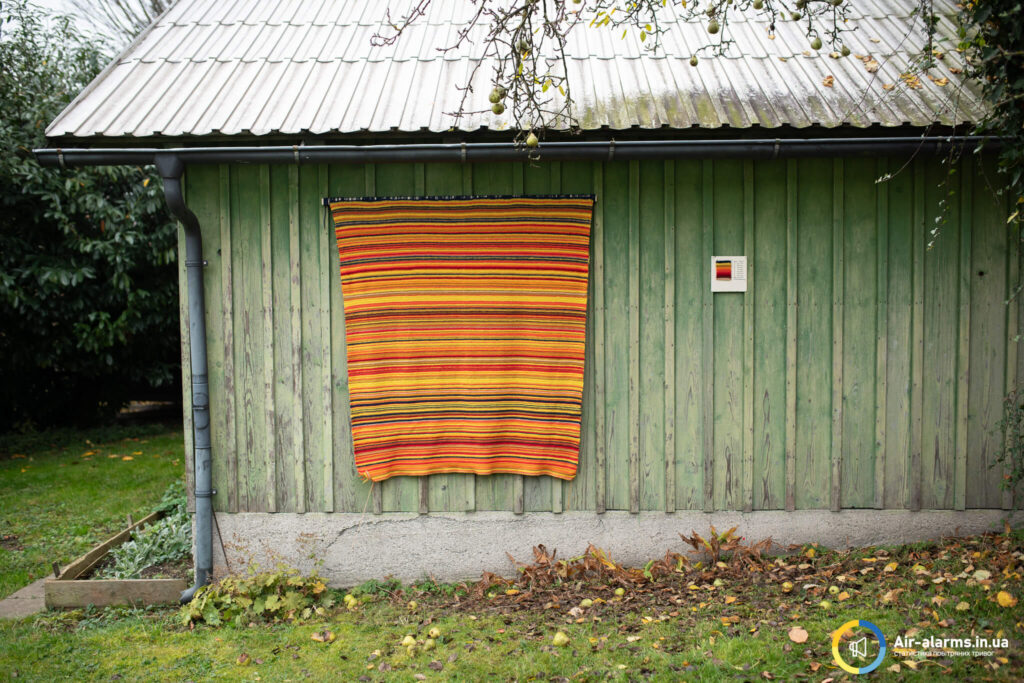
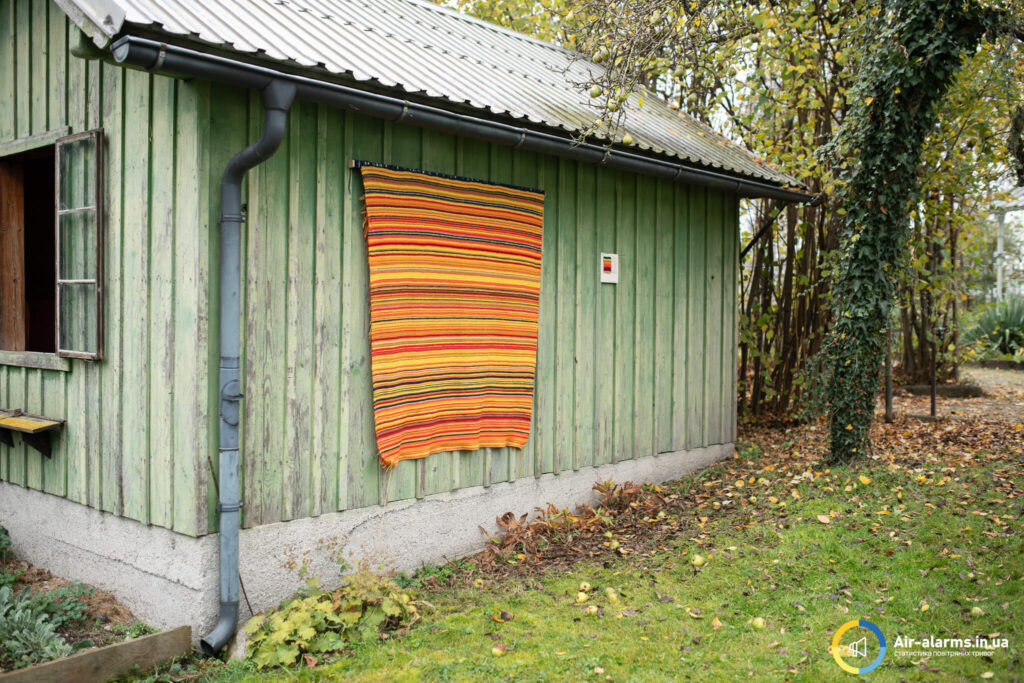
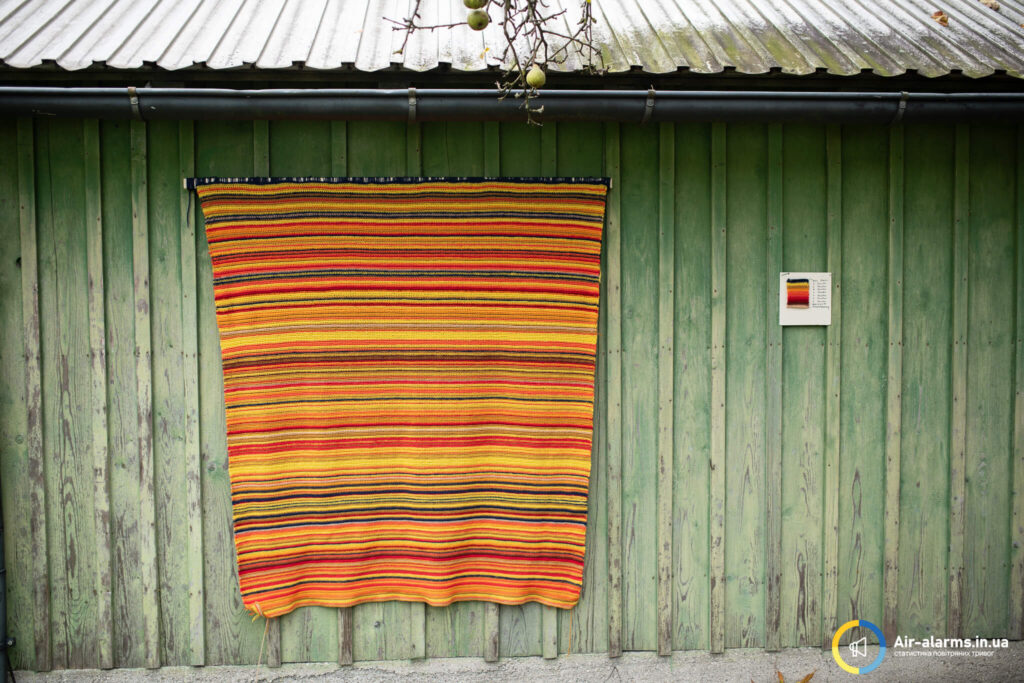
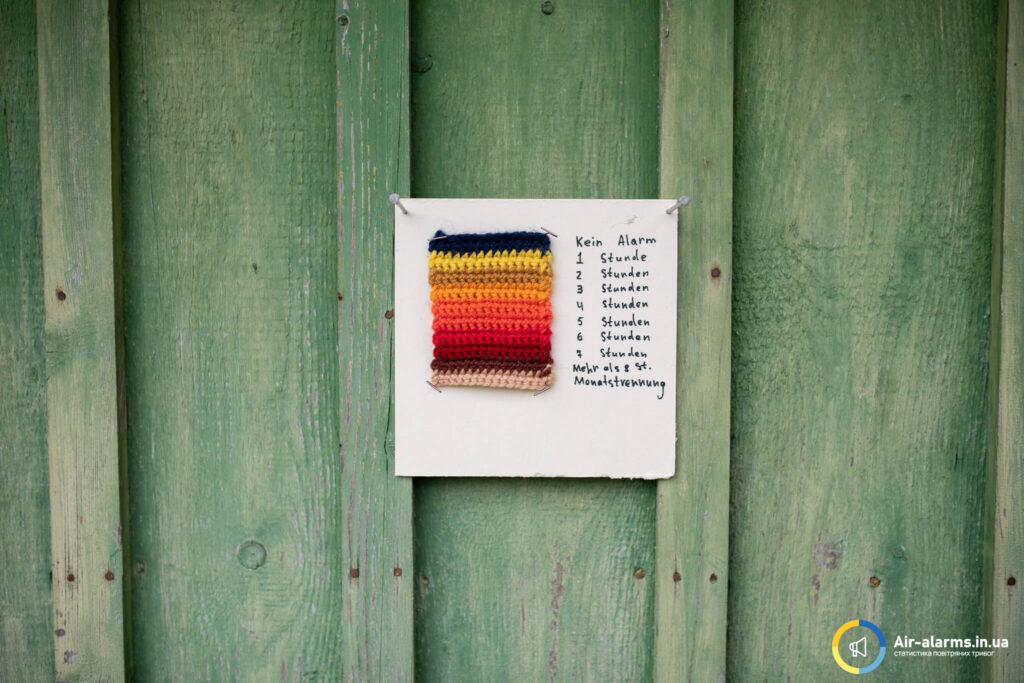
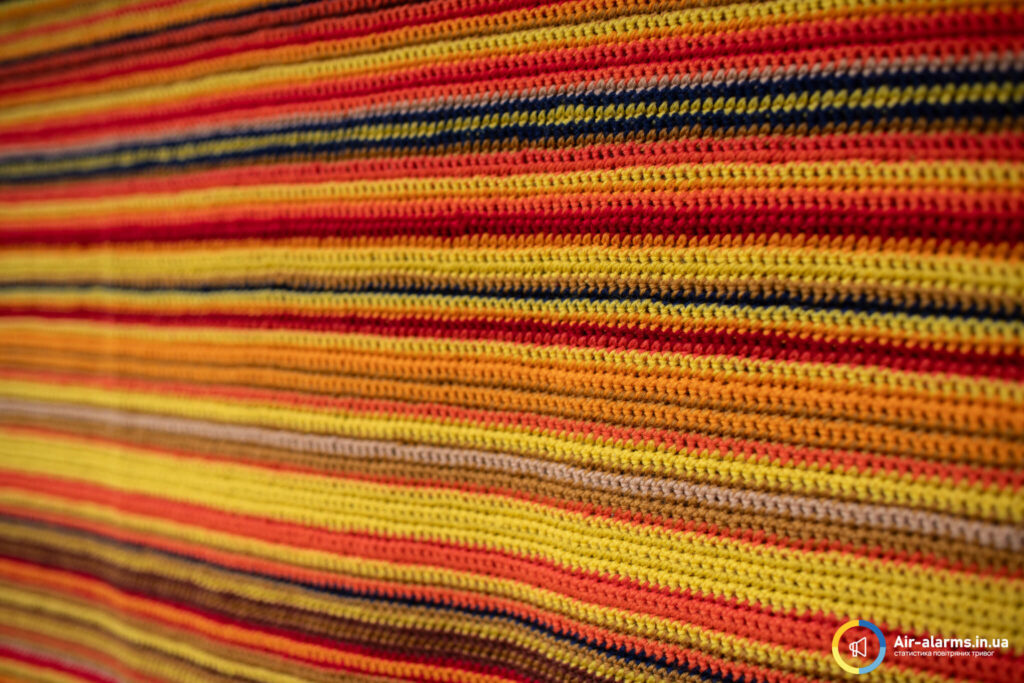
Photo by: Katharina Maria Wimmer
– How much material did you spend on this?
I can tell you how much I was missing. I have 9 colors there…. I ordered 250 grams of each color and very quickly, in the penultimate month, I ran out of yellow, which is responsible for air alarms that sound for less than one hour. And blue, by the way, is the one responsible for zero alarms.
– About the colors. You’ve already mentioned the heat map. It also reminded me of it. Tell me, did you use this logic to choose the “standard” yellow and orange colors or did you have some other idea?
Actually, I wanted to use only blue and red at first. But then I expanded to include yellow. It may be quite trite to say that blue is the color of calm, sea, sky, etc. And it’s my favorite color too. And red is the color of danger – it’s easy to read. And yellow and orange are like a transition to the highest, let’s say, level of danger.
– Are there any non-obvious meanings in this project that you may have intended in your work?
Yes, I guess there are two points for me, although I’m not quite sure about one of them. My first point is to choose a technique. I chose crochet because, as far as I know, according to my data, no machine has ever been able to reproduce crochet. It’s too hard for a machine. That is, all you sees is knitted with knitting needles. Well, by a machine, but with knitting needles.
I had an interesting conversation with a friend from Austria. He was like, “Are you sure?” I’ve already left him and then I get this message: “Well, listen…, earlier this year in Germany they made a prototype of a machine that can reproduce the hooking.”
When I chose this, I wanted to say that only a human being can do this, and in general, war is what one person, figuratively speaking, does to another, and it is difficult to understand… for me to understand.
And the second point…, this is also for me… I also do a lot of crocheting in my ordinary life, it’s a way to keep myself in some kind of balance, it’s part of my work with this topic, with my background and with what’s happening now.
– The first connected line, as I understand it, reflects the state of affairs on February 12? Why did you choose this first day of your stay in Ukraine as the starting point for your work?
Well, if I had chosen January 1, it would have been just a calendar. But this is my calendar, so to speak.
About the presentation of the work at an exhibition in Austria
– And you decided to present this project at an art event in Austria. Could you tell us what kind of event it was, what was its purpose, its specialty, etc.?
This is a collaboration between several organizations, you could say several people. First of all, it was part of the Kulturhauptstadt 2024 program, because this region, Salzkammergut, which is located in Austria, is the European Capital of Culture this year. Although I understand that the whole region is the capital – it sounds a little strange, but that’s the name. And there are three artists who founded the collective here in Linz. They all studied at our university, if I’m not mistaken. And they founded this initiative that this year researchers, students, and artists can spend some time in Gmunden, in a monastery. And there they can do research and organize an exhibition.
And, secondly, this is the professor I study with, Lucy Stahl. She organized all of this for our class. Back in the summer, I had a more precise idea of how to make the project, what colors to use, etc. And in early September, we received information from the professor that we had the opportunity to live there for two weeks and organize an exhibition at the end. And I was just like, “woohoo, woohoo,” and I started to urgently implement everything in order to make it all happen.
– Why did you decide to take part in this event in the first place?
All the stars just aligned. Because I knew it would be a blanket, but, for example, if I tried to show it in the summer, it would be too small and a person would not be able to read what it is, etc.
About the unusual location where the exhibition took place
– About the location. You mentioned in your correspondence and now during our conversation that it was a nunnery. Is it still active today?
It has been inactive for 2 years. The last sisters left two years ago because they were not young anymore. And somehow there were no new followers, as I understand it. And interestingly, they have been there since the XVIII century, as I know. It’s right in the center of this town. They never left, but they grew something in the garden. And they sold it through this gate. They did not see the outside world and the outside world did not see them. And, as far as I know, in some other chapels, at some time of the day, they also practiced silence.
– Do you know why you chose this particular location? Is it related to something or just an interesting location in itself?
Well, this is a transitional location, as I understand it. It seems to belong to the city. And it is not clear whether it will be made open to everyone, so that people can walk there and so on, or whether it will be sold…

– Is it a big territory at all?
The garden where we organized the exhibition is, in my opinion, a relatively large area. It’s smaller than a park, for example, but it’s definitely bigger than the garden that people have in front of their homes on average. There is a very large chapel, which is no longer in use. Then there is another smaller one. Then there are two chapels. And it was the houses where the nuns lived that we were not allowed to go to. We also lived on the territory, but it was a “hotel,” a guest house.
– Now I understand why the photos of your work in progress that you sent me earlier showed the same house where you presented this work. So you lived there and worked on the blanket?
Yes, partly there, partly at home, partly everywhere… (laughs). I took my work with me to different places as much as possible. Because at some point it became quite heavy… especially now it’s on this wooden stick… I sewed it on this stick and now the work is much less mobile and weighs 2.5 kg.
About the works of other participants of the exhibition
– Can you briefly tell us about the other participants and their works?
Yes. These were all my classmates. I think 10 people lived there permanently, and I was just visiting. Most of them, 4-5 persons, joined our class this year. That is, it was their debut, and it was a lot of hard work at once, you might say. Because it’s really hard to organize an exhibition in such a short time.
I also wanted to say something about the concept of the exhibition. Because this is a historic building, and in general, it’s not our university, it’s not Linz, we were given the task of changing as little as possible and leaving no traces as much as possible. Even to hang it so that it could be completely removed as if nothing had ever been there. No dowels, no screws…
Or you know, works that disappear over time. For example, the girl who took the photos of my work, her work was on the floor. She used this white paint… which is used to paint trees against pests… She was interested in the fact that this particular paint helps plants, but it is toxic to humans. And on that day, people had to walk on it with their feet.
There was another work that was related to this particular location, and I found it very interesting… It was a new student in our team. He worked with wax. Even with wax that was left over from candles in the monastery. He got it from the last sister who lives there and works on this whole garden. He took a map of the place and he had some very complicated technical diagram, he drew some lines and at the intersection of these lines at a distance of about 2 meters he made an impression of the inside of the wall, that is, the wall that surrounds the garden. And when he showed it to us, hung it up in the garden…, this wax is so thin that you think it’s paper. But if you look at it in the light, you can see these reliefs. It’s a very interesting work.
What visitors were interested in and what Austrians think about the situation in Ukraine
– Who were the visitors to the exhibition? Were there any Ukrainians among them?
First, it was the neighbors. The neighbors who live above the monastery. One of them even talked to me, asked how I liked it there. Mostly, there were locals, because it was a very, very cold day. And I think a lot of people from Linz, including students, didn’t go because it was too far, too cold, etc. But the locals were very interested. It seems to me that this is primarily because this monastery was closed for centuries. And only this neighbor told me that he had been there once in recent years because he cut trees for the sisters. And they were terribly curious about what was there, how it was, what the chapels looked like, and everything.
– Were there many people in general? Did the exhibition last all day?
Yes, from 12 noon to 6 pm. Although, the last hour can be excluded, because it was so dark that you could hardly see anything even with a flashlight. I would say that there were quite a lot of people, I was pleased. I talked to 10 people about my work myself, for sure. And this is a good result, I think.
– You said that there was a lot of good feedback and some questions from people. What did people generally ask you? Maybe there are some of the most popular questions?
(pauses thoughtfully). The same thing… what is my message for this work, what do the different colors mean, and what are my plans – will I continue it or will it just end in February, etc.
– Did they ask anything about the situation in Ukraine, about the events? Did they ask anything about the country itself?
Let me think… I think yes. But people still like to ask very personal questions. For example, where is my family, etc.
– In general, having lived in Austria for 3 years now, how can you characterize the attitude of Austrians towards Ukraine, the war, etc., and how aware are they of it?
Well, here again, we need to make two “ sections”. One section is my colleagues, other students, my professors, people who are also engaged in art. They are generally very critical of the world, of politics, of the media. There, of course, awareness has no limits. And there I rarely come across the fact that they repeat Russian propaganda. In general, people are understanding when I don’t want to discuss something for a very long time: my situation, the war in general, etc.
And there is another section – all the other people, especially middle-aged and older people. They are very much guided by what the TV says. And I often hear from them, “Are Russian and Ukrainian so different? Aren’t there unhappy people in Crimea who speak Russian and need to be saved?” And to be honest, it doesn’t make me feel very good. Unfortunately, it is difficult to convey anything to them. Because if they decide something…
About photography, ideas and museums
– I have to admit that when you wrote to me that you wanted to create an art project, I did a little Googling of your name. And I came across articles about a photo exhibition. You said you were studying photography, you participated in a photo exhibition, and maybe in some other exhibitions. Obviously, you’re involved in photography. What else do you do, perhaps? Apart from crocheting, apart from photography, are there any other areas?
Well, the most serious works I’ve made, the ones I’ve shown to the world are photographs, texts (yes, I write texts) and textiles. Although textiles are relatively new to what I present at the exhibition, etc.
– Were these Ukrainian exhibitions or foreign ones?
It was the only exhibition you googled that was in Ukraine. I had exhibitions only in Austria and one more in Germany. But these are group exhibitions, not my personal ones.
– Is it possible to see your photographs anywhere now?
It’s a bit difficult, because so far my works are not in any collections of museums or patrons, etc. But, as I said, I have had exhibitions. Mostly in Linz, for example, in Lentos, last year. It was the anniversary year – 50 years of our university. And the Lentos Museum is one of the most important museums of contemporary art in Linz and in Upper Austria as well. It was an exhibition of the best works of our university students. And this year, again, there was an exhibition of the best works of students, and I was again accepted with a work from the Polaroid.
– Perhaps we can see photos of the photos?
Yes, if I ever publish it…. On my Instagram, you can see the photos I used in my work, but for the most part, it’s not signed that this is from this cycle and this is from that cycle. This is my fault, of course. But usually, I take a photo, post it, and I don’t know if it’s just a picture, let’s say, or if it’s something more for me and it will become some kind of new work.
– You said you were going to continue this crochet work until February, so you want to reflect the year in it and then you won’t continue this project?
Yes, this is my plan. I will not continue this particular work. Of course, I’d really like to knit the winning blanket, an all-blue one.
– You’ll to do it! It’s a good idea!
– In conclusion, I want to ask you this question: if you were to create an art project that would be shown all over the world and a lot of people would see it, what would you show and tell about Ukraine in it?
Before I answer this question, I would probably like to praise a little bit the work that some museums are doing now. Not all of them, of course, but, for example, the Museum of Contemporary Art in Cologne, which is engaged in the de-imperialization of Ukrainian artists. Last year, I visited an exhibition where they finally “washed away” this fact that Malevich and other avant-garde artists are not Russians. They also told the story of Les Kurbas and other artists who were killed and repressed.
This is very important work. Of course, this is a drop in the bucket.
And now to what I would personally like to do. I would probably love to organize an exhibition, that is, to act as a curator. For artists, let’s say, of my generation, that is, young artists. Because I think it’s a super opportunity that we are given the opportunity to show our work at the university, regardless of whether a person has a name… Well, what name a student can have at the age of 20… but it doesn’t mean that they have to spend years learning to hold a brush and only then show that I painted this or photographed this. And that there should still always be time for art at any age, even during the war…
Join our communities to receive interesting information on air alarm statistics
Facebook page: https://www.facebook.com/airalarms.in.ua
Telegram channel: https://t.me/airalarms_in_ua
There you will find a lot of information and interesting facts from the statistics we have published before and will continue to publish for you throughout the entire period of the war.
If you are willing and able to support our project, we will be sincerely grateful for any donation: https://send.monobank.ua/jar/6SdK4xAGpS
Glory to the Armed Forces of Ukraine! Glory to Ukraine!